From the 1st-century B.C. to the 4th-century, A.D., the citizens of Spoletium gathered in their teatro for evening pleasures Theatrical, dance and musical presentations again animate the teatro romano which often backdrops Spoleto’s Two Worlds Festival ….and not…
When you arrive by train to Spoleto, take the short walk to the nearby 12th-century Romanesque splendor, Basilica di San Gregorio Maggiore, dedicated to Spoleto’s San Gregorio, priest martyred in 304 A.D.…
Renowned historian and archaeologist, Giuseppe Sordini has deemed Spoleto’s Basilica di San Salvatore “maggiore monumento spoletino dell’antichità,” that is, Spoleto’s greatest monument to antiquity. In fact, although its exact origins are unknown, the…
When the 28-year-old Lord Byron was in Spoleto in 1816, he was captivated by the Fonti del Clitunno “the purest God of gentle waters! And most serene of aspect, and most clear,..,” Byron’s lauded the Clitunno…
Spoleto’s Piazza del Mercato (Market Square) was once site of the forum of Roman Spoletium. A narrow street leading out the square is flanked by the medieval botteghe (shops) with arched doorways and stone display counters…
As she opened the cloister door so that we could return into the church, I asked Suora Giacinta how many sisters lived in her Montefalco Augustinian cloistered convent, “Ten,” she told me,”…
Spoleto’s Church of Sant’Eufemia has been aptly described as “a jewel of a church, situated inside the courtyard of archbishop’s palace and inspiring a profound sense of welcome, fascinating us with its…
Fortunately, some remains of the ancient world still stand proudly, like the 1st-century A.D. Roman theater of Spoleto….. ..and the 1st-century B.C. Temple to Minerva in Assisi ….……but others are hidden below…
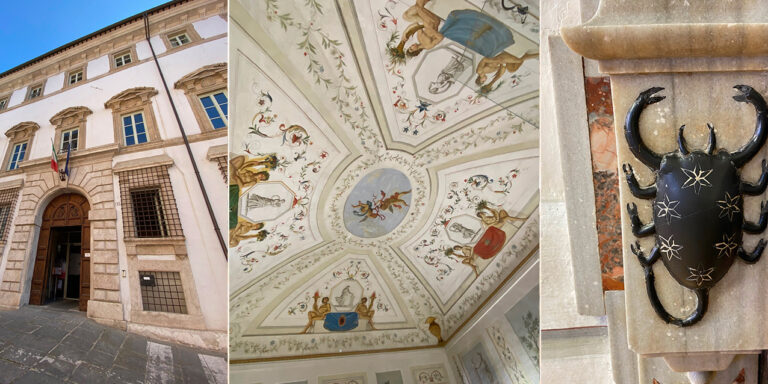
As you wander the labyrinthine medieval backstreets of Spoleto, you’ll pass many an imposing noble palazzo. And certainly the elegant seventeenth-century Palazzo Mauri should be a stop for bird-lovers and ornithologists. The building was…
Rising behind the 12th-century Church of San Pietro extra moenia (outside the walls) is Monteluco, the sacred woods of the Romans, protected by the 3rd-2nd-century B.C. law, Lex Luci Spoletina which forbade the cutting of its trees.…