Bevagna’s Festival in June Heat: Passione

At the end of June, it’s hot in Bevagna, medieval hilltown of Roman origins in the Valle Umbra Nord, Umbria’s largest valley. Not exactly the ideal day for dressing in heavy woolen capes or jute or velvet gowns – or armor (!) – or for forging bronze bells, baking bread in a stone bread oven, minting coins, glass-blowing or tanning leather. Not even to be imagined: unless you are Bevignate. Months of work on their medieval festival, the Mercato delle Gaite, are coming to fruition now as the town relives its medieval culture and history…with passione.
read more…

Umbria’s Sacred June Rites

It will soon be time to gather the wildflowers, weeds, grasses and leaves for the wondrous rural concoction, l’acqua di San Giovanni. After all, no morning wash is more glorious than that of Umbria’s rural people in the early morning of June 24th. On June 23rd at sunset, vigil of the Festa di San Giovanni Battista, the farmwomen head out into the fields with baskets or bags to gather the cento erbe (literally,”one hundred greens or plants”, though flowers as well as plants are picked). The flowers and plants will then be soaked all night in a basin – outdoors. The flower-filled basins of water must never enter the home.
read more…

La Scarzuola:  From St. Francis to Savador Dali

A recent visit to La Scarzuola, in northern Umbria – where our region almost merges with Tuscany – plopped me right into a surreal world of Dali-Miro’-Escher-Fellini-like bizzarities. The name “Scarzuola” derives from a marsh plant of the area, “la scarza”, used by San Francesco di Assisi, legend tells us, to build himself a shelter here in the early 13th century.
read more…

La Sagra: Something Sacred?

There certainly is something sacred about the sagra: a local village festival offering the best in local cuisine at minimal prices, top (and free!) dance band music outdoors til the wee hours and entertainment for all from pre-schoolers to the elderly. At some sagras, there are mini-soccer tournaments, others offer a performance of a local dancing school on one night, and others fill the food tent walls with artwork of the village school children.
read more…

Auguri, Italia!

No, Italians are not flag-fliers. A nationalistic sense of being Italian is missing. For an Italian, first reference point is the family. If you are Italian, identity point is the section of the town where you grew up (whether it be called quartiere, terziere, rione, or contrada). After all, most festivals are about competitions between town districts.
read more…

Novella’s Last Wild Asparagus

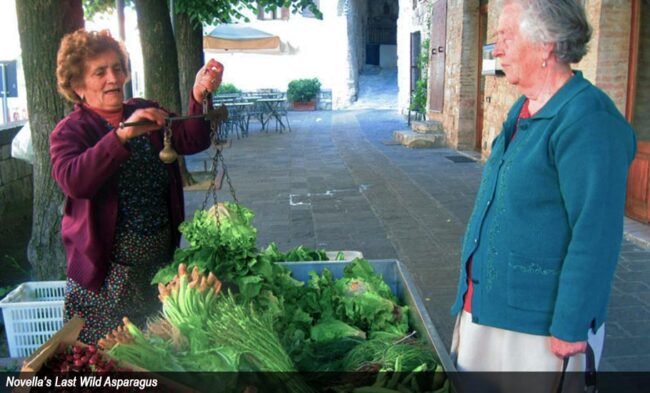
Farmwoman Novella had a couple tempting bunches of wild asparagus at her vegetable box (to call it a “stand” would be an exaggeration) in the Assisi “piazzetta” the other morning. I stopped by early to chat with Novella and husband Bruno as they unloaded their 3-wheeled Ape (“bumble bee”, literally, but maybe best described as a “scooter truck”) and set up their farm abundance for morning sale.
read more…

May 9th: Remembering an Anti-Mafia Hero

Pino and I will head to the meeting tonight (May 9th) in Assisi in memory of courageous young Sicilian Peppino Impastato, eliminated by the Mafia on May 9th, 1978 for his outspoken criticisms of Mafia crime via the Radio Aut he started (his brilliant broadcasts were often full of irony and cutting humor) in his small hometown of Cinisi, not far from Palermo.
read more…

Calendimaggio: Assisi’s Glorious Celebration of Spring

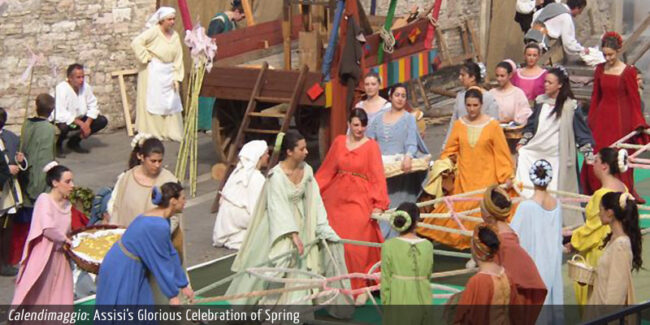
Since time immemorial, man has heralded the arrival of spring with ritual and festivity. In Assisi, committees meet nightly for months to plan the annual traditional salute to spring, the Calendimaggio. The three-day festival – which lasts three days – is a re-evocation of the medieval celebration of Nature’s rebirth and the initiation once again of the life cycle.
read more…

Singing in May in Umbria…

Pino and I had been working the land here outside of Assisi for about eight months and collapsed into bed exhausted on April 30th (1975) – as we did most nights in those days! At around 2:00 am, we were awakened by robust, joyous male voices singing under our window, accompanied by rollicking accordian music and the jangling of a tamburine: our first introduction to the maggiaioli! (“May singers”).
read more…